ASR
A plugin for Alakazam
Tools > 2. Artifact Rejection / Reduction > ASR · continuous → continuous · ASR
Artifact Subspace Reconstruction, from EEGLAB’s clean_rawdata plugin (Mullen et al. 2015). It first finds scalp channels that are flat for too long or that their neighbours predict poorly, and interpolates them. Then it learns, from the cleanest stretches of the recording, what the scalp’s covariance normally looks like; wherever a sliding window’s variance exceeds that by more than the burst criterion along some direction, the offending components are reconstructed from the clean ones. Large, brief artefacts (movement, electrode pops, muscle bursts) are repaired, and the rest of the recording is untouched.
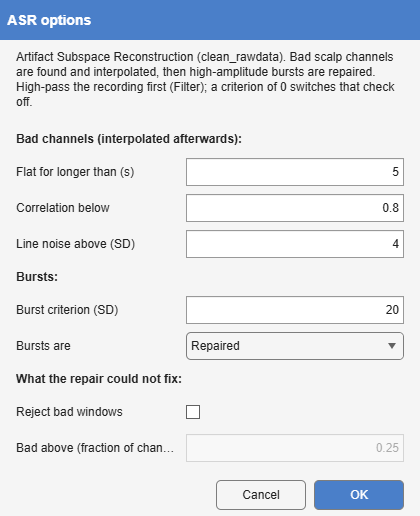
| Option | Default | Meaning |
|---|---|---|
| Flat for longer than | 5 s | A channel flat for longer than this is bad; 0 switches the check off. |
| Correlation below | 0.8 | A channel correlating less than this with its prediction from its neighbours, for more than half the recording, is bad; 0 switches it off. |
| Line noise above | 4 SD | A channel with this much more line noise than the rest is bad; 0 switches it off. |
| Burst criterion | 20 SD | How far a window may exceed the calibration before it is repaired. Lower is more aggressive. |
| Bursts are | Repaired | Repaired, or Rejected: every sample ASR would change is marked rejected instead. |
| Reject bad windows, Bad above | off, 0.25 | After the repair, reject windows in which more than this fraction of the channels are still out of range. |
ASR assumes data without slow drifts, so high-pass the recording first (Filter, about 0.5 to 1 Hz). clean_rawdata applies its own high-pass inside the same function; here it is left to Filter, so that each operation is a step of its own in the tree, and ASR warns when the recording still carries large offsets. The flagged channels are interpolated back in their own places, so the montage is unchanged. A rejected stretch is marked rejected (NaN) on every channel rather than cut out, so the recording keeps its length and its events their latencies; an epoch cut across it keeps NaN there, which Average leaves out sample by sample. Only scalp channels with a position calibrate ASR and are cleaned; the others are left as they were.
clean_rawdata ships with EEGLAB and is installed through EEGLAB’s plugin manager when it is missing. The data-quality report lists, per subject, the channels interpolated, the share of samples repaired and rejected, and the criterion used.