Collapse Hemispheres
A plugin for Alakazam
Tools > 1. Preprocessing > Collapse Hemispheres · averaged → averaged · CollapseHemispheres
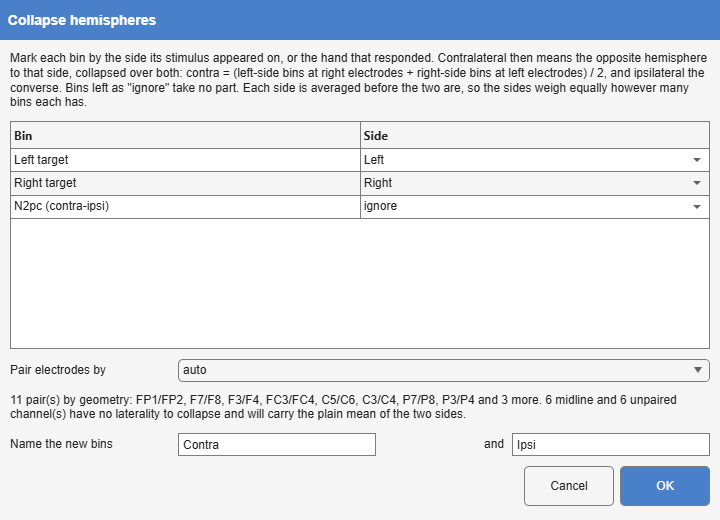
Produces the contralateral and ipsilateral waveforms of a lateralised component, the N2pc (Luck and Hillyard 1994; Eimer 1996) or the LRP (Coles 1989), collapsed across every pair of lateral electrodes at once. Each bin is marked by the side of its stimulus (or the hand that responded), and two bins are added:
where and are the averages of the left-side and right-side bins. Each side is averaged before the two are combined, so the sides weigh equally however many bins each has; with one bin a side this is ERPLAB’s expression.
| Option | Default | Meaning |
|---|---|---|
| Side of each bin | ignore | Left, Right, or ignore. |
| Pair electrodes by | auto | geometry (mirroring positions through the midline), labels (10-20 odd and even numbers, or an L/R letter), or auto, geometry when positions exist. |
| Name the new bins | Contra, Ipsi | The labels of the two added bins. |
The collapsed waveform of each pair is written to both of its electrodes, so that the new bins have the same channels as the old ones: the Contra bin at PO7 and at PO8 is the same contralateral waveform, scalp maps still draw, and a measurement window defined on PO7 keeps working. Midline and unpaired electrodes carry the plain mean of the two sides. Standard errors are propagated as for any combination bin (Average).
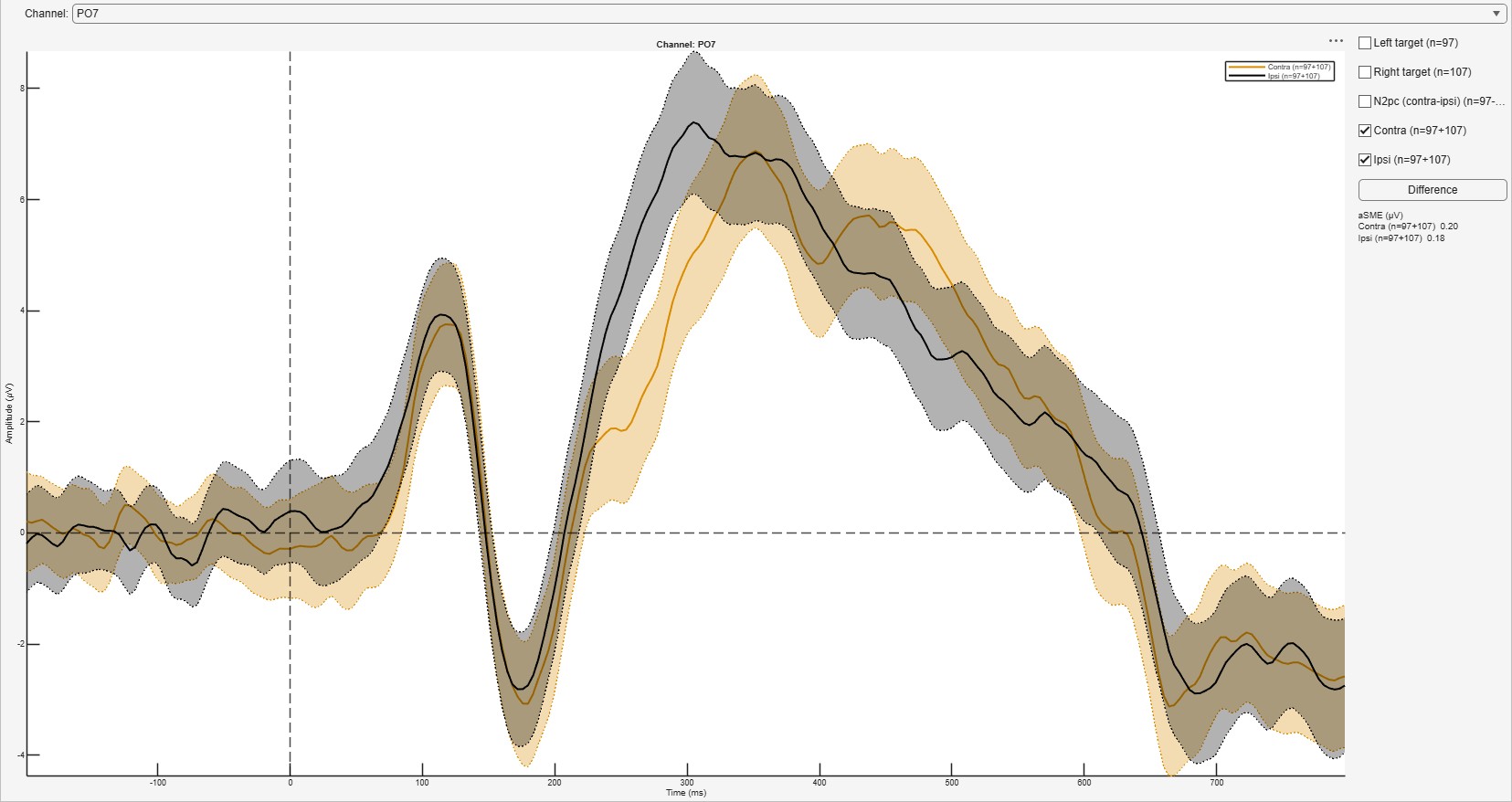
The contra-minus-ipsi difference alone can also be had without side assignments, by combining Derive Channels (let C34 = C4 - C3) with a difference bin (bin 3 = 0.5 bin 1 - 0.5 bin 2), which agrees with ERPLAB to within 10-14 µV. What that route cannot give is contra and ipsi separately, or every pair at once.
Toolbox or own code. ERPLAB reaches the same waveforms by composing a channel operation and a bin operation, as in Luck’s BinOps_Contra (Luck 2022); Alakazam does it in one step, and agrees with ERPLAB’s result to 6.7e-15 µV.