Eye tracking
A plugin for Alakazam
Tools > 1. Preprocessing > EyeTracking · continuous → continuous · EyeTracking
Joins the EyeLink recording of the same session onto the EEG, using EYE-EEG (Dimigen et al. 2011): the tracker’s clock is aligned with the EEG’s through the triggers both received, its gaze and pupil signals are added as channels of type EYE (which nothing treats as scalp EEG), and its saccades, fixations and blinks are added as events. Those events can then be binned like any other (fixation-related potentials) and modelled as covariates in deconvolution (Overlap correction by deconvolution).
The eye-tracking file is found by name: subject1.set goes with subject1.asc beside it, which is what lets one set of options be replayed on every subject. When only an .edf is present and SR Research’s edf2asc is installed, it is converted first.
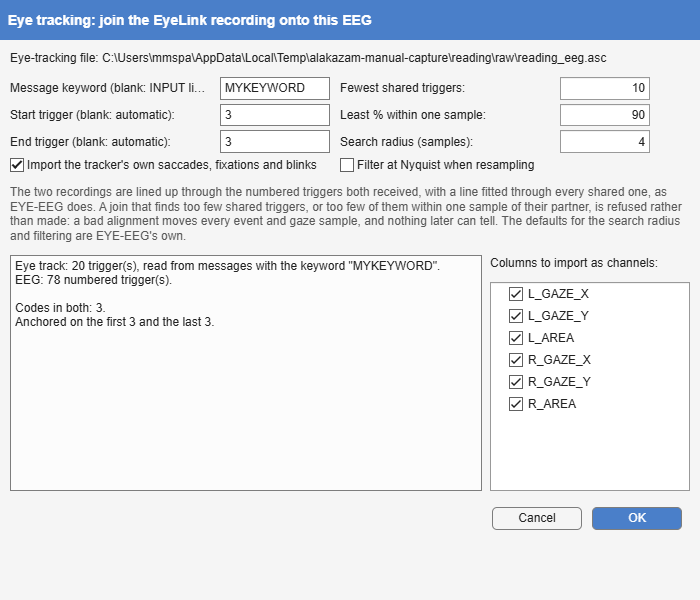
| Option | Default | Meaning |
|---|---|---|
| Message keyword | blank | The keyword of the EyeLink messages that carry the triggers (MYKEYWORD 123); blank reads the parallel-port input lines instead. |
| Start trigger, End trigger | automatic | The codes the alignment is anchored on (the first of the one, the last of the other); automatic takes the first and last code both recordings share. |
| Import the tracker’s own saccades, fixations and blinks | on | Add them as events. |
| Filter at Nyquist when resampling | off | EYE-EEG’s own option, and its default. |
| Fewest shared triggers | 10 | Refuse a join with fewer. |
| Least % within one sample | 90 | Refuse a join in which fewer of the shared triggers end up within one sample of their partner. |
| Search radius | 4 samples | How far either side of an EEG trigger to look for its partner (EYE-EEG’s default). |
| Columns to import | all | The tracker’s columns to add as channels, by name. |
A poor synchronisation is silent: every event lands a little away from the EEG it belongs to, and nothing downstream can tell. The join is therefore checked. EYE-EEG returns the dataset unchanged when it finds no shared triggers, and that is refused; its record of how far each shared trigger landed from its partner is summarised and refused below the two limits above; and the summary is kept, so that the data-quality report states the synchronisation for every subject (Data quality).
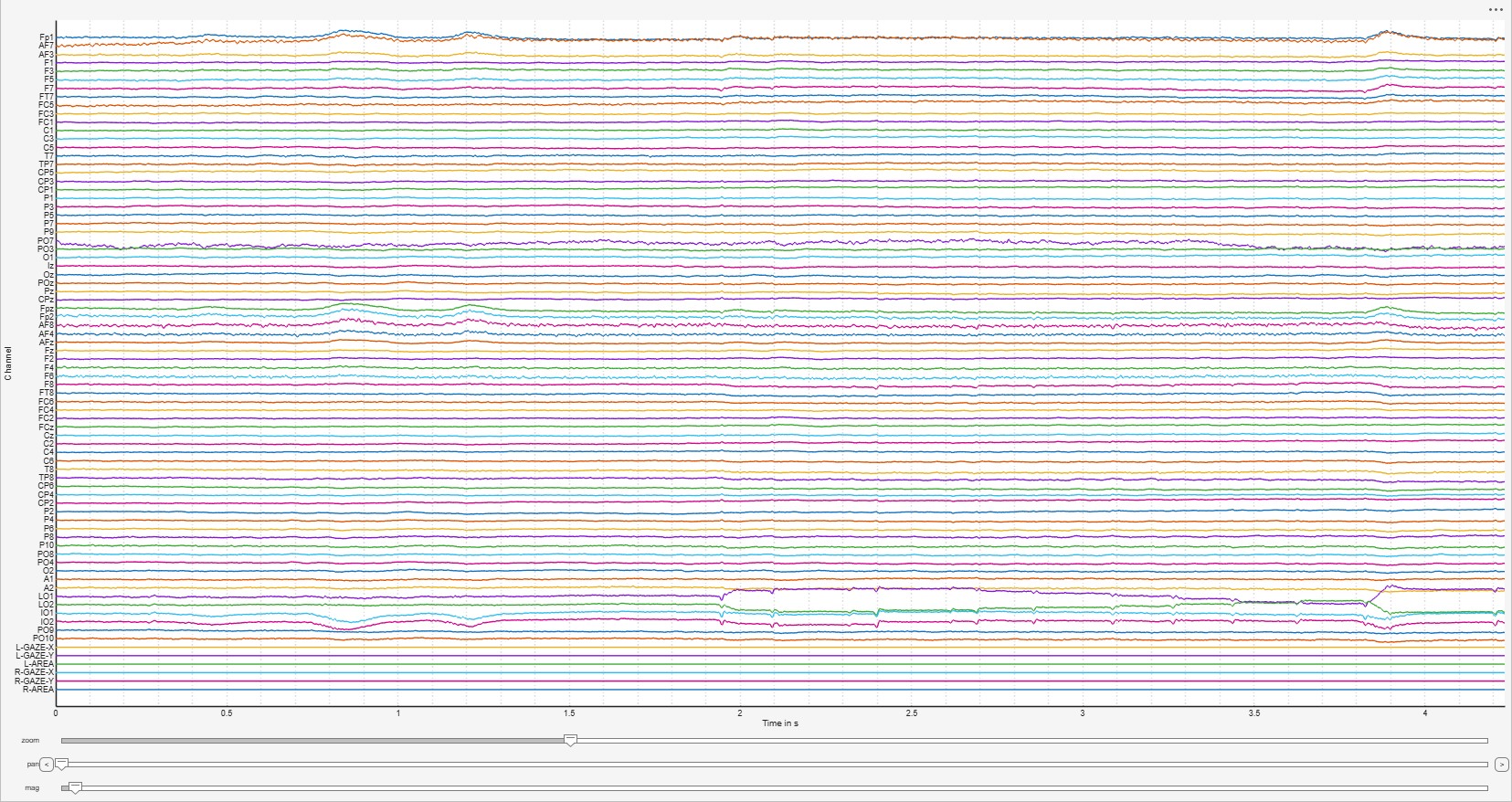
L-GAZE-X to R-AREA) below the EEG.